

2026 PRICING GUIDE
How Much Does a French Drain Cost in Bryan–College Station? (2026)
By GreenRiver Landscaping · Updated · 10 min read
Quick answer
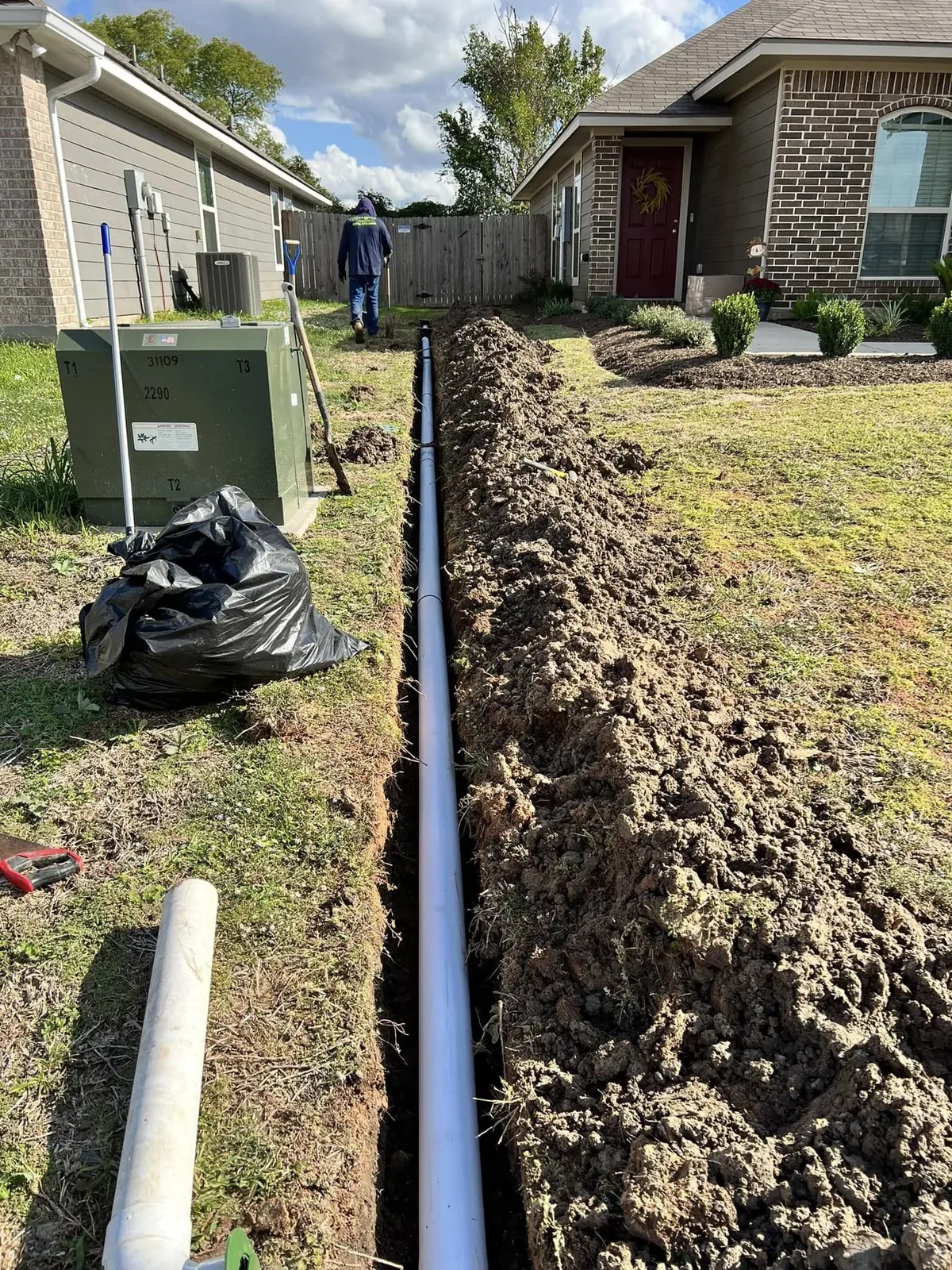
A standard yard French drain in the Bryan–College Station area costs about $20–$31 per linear foot installed, according to a published College Station cost survey.
- 50 feet: roughly $1,000–$1,550 at that local per-foot rate.
- 100 feet: $2,020–$3,150 in the same College Station survey.
- 200 feet: roughly $4,000–$6,200 at the local rate; national guides show a much wider spread.
- Buried downspout tie-in: about $225–$350 per downspout nationally, pop-up emitter included.
- Regrading instead: about $1–$2 per square foot, with a national average near $1,800.
Most residential yard drains land in the low-to-mid thousands. The thing that moves the price most is not the pipe; it is how deep the trench goes and what sits in its path: sod, beds, sprinkler lines, or concrete. GreenRiver has not published prices and quotes each job after walking the property, with a free written estimate.
These are published area averages from the sources listed at the end of this guide, not a GreenRiver price list. We quote every job after seeing it, and the estimate is free and in writing.
What actually drives the cost of a French drain
Five things set the price of a French drain: length, depth, where the water has to go, what is in the way, and the ground itself. Pipe and gravel are the cheap part. Labor and restoration are where the money goes.
1. Length of the run
Drains are priced by the linear foot, so length is the starting number. A short run along one side of the house might be 40–60 feet; a drain that wraps the back of the lot and runs to the street can pass 150–200 feet. Published College Station figures scale almost straight-line with length, from $400–$630 for 20 feet to $2,020–$3,150 for 100 feet.
2. Trench depth
Deeper trenches cost more because every extra foot of depth is more digging, more spoil to haul, and more gravel to fill. The College Station survey notes that a shallow surface drain is the least expensive, while drains needing a 2-, 3- or 4-foot trench get more expensive the deeper they go. A drain meant to catch surface runoff can stay shallow; one meant to intercept groundwater near a foundation usually cannot.
3. Where the water discharges
A French drain only works if the water has somewhere lower to go. Running it to daylight at a lower part of the lot or the street is usually the cheapest outlet. If there is no fall to daylight, the system needs a pop-up emitter, a longer run, or a dry well, and each adds cost.
4. What is in the trench line
Sod, flower beds, sprinkler lines, tree roots, fences, and concrete walks all sit in the path of a typical drain. Each one means careful hand work, a repair, or a cut. National data shows the per-foot price climbing sharply by location: $20–$30 in an open yard, $45–$55 at a driveway, and $50–$80 tight around a house.
5. The soil
Brazos County clay is dense, sticky when wet, and hard as brick in August. It slows trenching, and it is also the reason drainage matters here: clay barely absorbs water, so it sheds it across the surface and toward whatever is lowest, often the slab.
French drain cost breakdown by component
The materials in a French drain are inexpensive; most of the price is labor, equipment, and putting the yard back. The figures below are published national averages unless marked as College Station.
| Item | Typical range | Notes |
|---|---|---|
| Installed yard French drain (College Station) | $20–$31 per linear foot | Local survey; includes trenching, pipe, gravel |
| Installed exterior French drain (national) | $10–$65+ per linear foot | Wide range; depth and access drive it |
| Perforated drain pipe (material only) | $0.50–$3 per linear foot | Small share of the total |
| Pea gravel (material only) | $25–$53 per ton | A 100 ft trench uses several tons |
| Landscape fabric (material only) | $0.45–$0.80 per sq ft | Keeps clay fines out of the gravel |
| Yard drain / catch basin | $150–$200 | Collects surface water at a low spot or downspout |
| Buried downspout with pop-up emitter | $225–$350 per downspout | About $15–$20/ft of pipe plus ~$150 for the emitter |
| Dry well (where there is no outlet) | $1,344–$5,167 | Only when water cannot run to daylight |
| Permit, where required | $50–$225 | Many simple yard drains need none; ask the city |
French drain vs. channel drain vs. downspout tie-ins vs. regrading
A French drain is the right fix for water that soaks in and sits; it is not always the right fix for water that sheets across the surface. Many Bryan and College Station yards need one of the options below, or a combination.
| Option | Typical cost | Best for | Limits |
|---|---|---|---|
| French drain | $20–$31/ft (College Station); $10–$65+/ft national | Soggy ground, water along a slab, long wet strips | Needs fall to an outlet; clay can slow intake |
| Channel (trench) drain | $30–$100 per linear foot | Water sheeting off a driveway, patio, or garage apron | Handles surface water only; set into concrete |
| Buried downspout tie-in | $225–$350 per downspout | Gutters dumping water against the foundation | Only moves roof water |
| Catch basin | $150–$200 | A single low spot that ponds after storms | Must be piped to an outlet |
| Regrading | $1–$2 per sq ft; ~$1,800 average | Ground sloping toward the house | Needs room to create fall; may need fill |
French drain
A French drain is a gravel-filled trench with perforated pipe that collects water from the soil and carries it away. It is the fix when the ground stays wet for days after rain or water collects along the foundation, as covered on our drainage and excavation page.
Surface or channel drain
A channel drain is a slotted grate set flush in concrete that catches water running across a hard surface. It is the better choice when a driveway or patio pitches water toward the garage or back door.
Downspout tie-ins
Tying downspouts into buried solid pipe moves roof water well away from the slab, often ending at a pop-up emitter in the lawn. On many houses, gutters dumping at the corners are the whole problem, and tie-ins cost far less than a full perimeter drain.
Regrading
Regrading reshapes the soil so it falls away from the house. When the problem is simply negative slope, it fixes the cause rather than catching the symptom, and national averages put it around $1,500–$2,600 for a typical job.
French drain cost by project size
At the published College Station rate of $20–$31 per linear foot, total cost tracks length closely. The tiers below use that rate; the national figures are shown for comparison and run wider because they include harder sites.
Small: about 50 feet
A 50-foot drain, such as one side yard from a downspout to the front, works out to roughly $1,000–$1,550 at the local rate. National data puts 50 feet of exterior drain at $1,250–$2,000.
Medium: about 100 feet
A 100-foot drain across the back of a typical lot is listed at $2,020–$3,150 in the College Station survey. National figures for the same length run $3,500–$4,000, and some guides stretch to $1,000–$6,500 depending on depth.
Large: about 200 feet
A 200-foot system wrapping two sides of the house and running to the street works out to roughly $4,000–$6,200 at the local per-foot rate. National guides list $2,000–$15,000 for 200 feet of exterior drain, a range that shows how much depth, access, and restoration matter at this size.
Local factors in Bryan–College Station
Brazos Valley soil and weather make drainage more important here than in many places, and they also shape how a drain has to be built.
- Clay soil. Brazos County clay absorbs water slowly and sheds it fast. A drain here needs fabric to keep fine clay from clogging the gravel, and enough fall to move water before it backs up.
- Heavy storm events. Central Texas rain tends to come in bursts, several inches in a few hours, rather than steady drizzle. A drain sized for a light shower can be overwhelmed; outlets and pipe size need to handle a real storm.
- Slab foundations. Most homes here sit on slabs. Clay swells when wet and shrinks when dry, so water pooling against one side of a slab while the other side stays dry is exactly the uneven movement that leads to cracks and sticking doors.
- Summer heat and drought. Clay baked hard in July and August is slow to dig, and trench walls in wet clay in spring can slump. Timing affects how quickly the work goes.
- City and HOA rules. Water cannot simply be dumped onto a neighbor’s lot. Where a drain discharges to the street or an easement, check with the City of Bryan or College Station and any HOA before work starts.
The same work is available on both sides of Texas Avenue; see our College Station drainage page for local details.
When grading alone fixes the problem
Regrading alone is often enough when water is running toward the house across the surface rather than sitting in the soil. If the yard slopes back toward the slab, a drain only catches water the grade is sending the wrong way.
- Water flows toward the foundation during rain and drains off within a few hours afterward.
- Beds or soil have been built up against the house over the years, so the ground sits higher than it should at the slab.
- There is enough room on the lot to create a gentle slope away from the house.
- Downspouts are already extended or tied in, and the problem remains.
A French drain is the better answer when the ground stays saturated for days, when there is no room to change the slope, or when water is coming from a neighbor’s higher lot. Often the best result is grading plus downspout tie-ins, with a shorter drain only where it is needed. Rebuilding beds at the right height is part of that work.
Mistakes that cost homeowners money
Most failed French drains fail for the same few reasons, and nearly all of them are decided before the first shovel goes in.
1. Hiring on price alone
The cheapest bid is often the shallowest trench, the least gravel, and no fabric. It looks the same when the sod goes back down and clogs within a few seasons in Brazos clay.
2. No fall to a real outlet
A drain that runs level or ends in a low spot simply stores water underground. Ask where the water ends up and how much slope the pipe has along the way.
3. Skipping the filter fabric
Without fabric, fine clay particles migrate into the gravel and pipe. The drain slowly silts up, and the fix is digging it all out again.
4. Treating the symptom, not the cause
Installing a long perimeter drain when the real problem is a downspout dumping at the corner or soil sloping toward the house wastes money. Fix grade and gutters first, then drain what is left.
5. Tying downspouts into the perforated pipe
Roof water pushed into a perforated French drain can flood it and soak the very soil you are trying to dry. Downspouts belong in their own solid pipe.
How to compare French drain quotes
A real French drain quote spells out the route, depth, materials, outlet, and restoration in writing, so you can compare bids line by line instead of by the total alone.
- Route and length: where the drain starts and ends, in feet.
- Trench depth and width, and how much fall the pipe will have.
- Materials: pipe type and diameter, gravel type, and whether fabric wraps the trench.
- Outlet: daylight, curb, pop-up emitter, or dry well, and where it sits.
- Downspouts: whether they are tied in with separate solid pipe.
- Restoration: sod, beds, sprinkler repair, and concrete patching, each marked included or extra.
- Locates and cleanup: who calls 811 and what happens to the excavated clay.
GreenRiver walks the yard, looks at where the water sits and where it can go, and puts the scope in a free written estimate. You can request a free estimate, see drainage and grading jobs on our work page, or read more on the Bryan drainage page.
FAQs
THE SERVICE
Drainage & Excavation from GreenRiver
French drains and drainage systems that carry water away from the foundation, plus grading and excavation for patios and site prep.
Sources
- HomeBlue — French Drain Cost in College Station, TX — local per-foot rate and 20–100 ft totals, May 2024
- Fixr — French Drain Installation Cost — national averages by length and location, updated Jan 2025
- LawnStarter — How Much Does a French Drain Cost? — national per-foot, material, dry well and permit costs, 2026
- Lawn Love — How Much Does a French Drain Cost? — national 200 ft range and sod-laying cost, 2026
- Lawn Love — Lawn Drainage Solutions — catch basin, downspout, channel drain and dry well costs, Aug 2026
- Fixr — Cost to Regrade Yard — national regrading averages, updated Jan 2025
- LawnStarter — Sprinkler Repair Cost — broken sprinkler pipe repair, national, 2026
- ThePricer — Saw Cutting Concrete Cost — national per-foot and minimum charges, 2026
- City of Cleburne — Texas811 — Texas two-business-day notice rule; service is free
More cost guides
BRYAN, TEXAS — 30.6519° N, 96.3856° W
GET YOUR OWN NUMBER.
Averages only go so far. Send a few photos or have us walk the property, and you get a written estimate for your yard — free.