

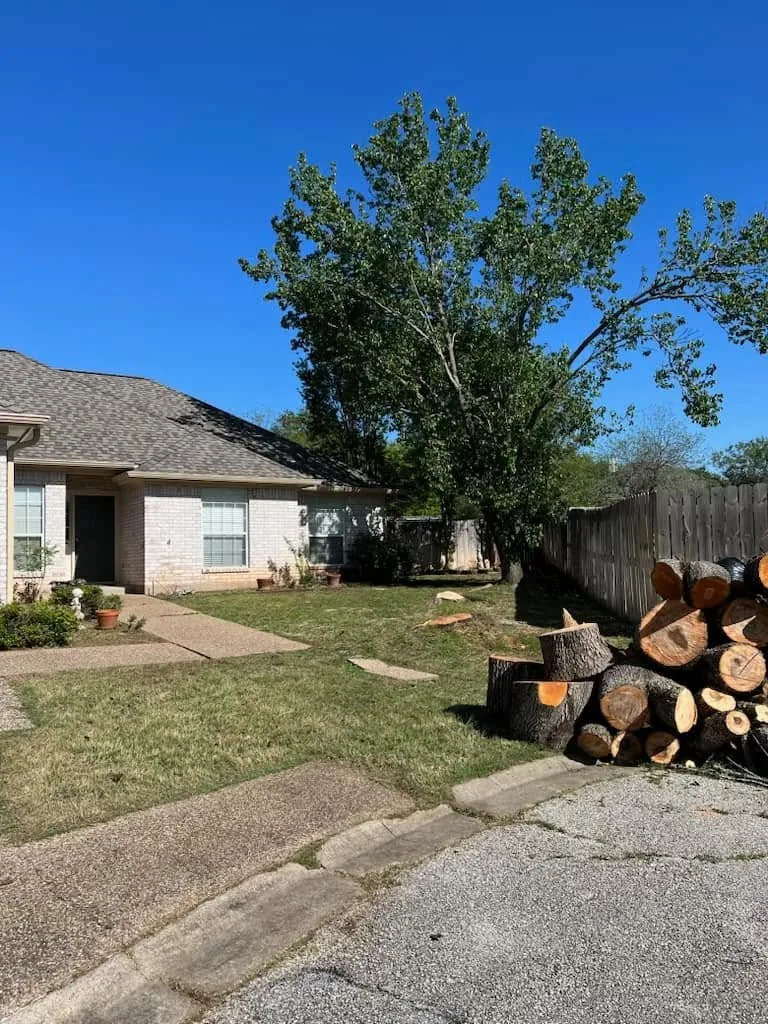
2026 PRICING GUIDE
How Much Does Tree Removal Cost in Bryan, TX? (2026)
By GreenRiver Landscaping · Updated · 10 min read
Quick answer
Most residential tree removals in Bryan and College Station cost between about $300 and $1,500, with a College Station cost survey putting the average near $900.
- Small trees (under 30 ft): roughly $190–$560 in one College Station survey; $150–$400 nationally.
- Medium trees (30–60 ft): roughly $290–$1,110 locally, depending on height within the band.
- Large trees (60 ft and up): roughly $580–$1,490 in one local survey, and $1,140–$4,750 in another that counts 50 ft and up as large.
- Stump grinding: usually priced separately — about $75–$1,000 per stump in a College Station survey.
- Emergency or storm work: national data puts it at two to three times the normal price.
A typical single yard tree with the wood hauled off lands in the high hundreds; a big oak over the roof, with a stump to grind, can run into the low thousands. How close the tree is to the house moves the number more than anything else. GreenRiver has not published prices — we quote each tree after seeing it, with a free written estimate.
These are published area averages from the sources listed at the end of this guide, not a GreenRiver price list. We quote every job after seeing it, and the estimate is free and in writing.
What actually drives the cost of tree removal
Five things set the price of a tree removal: height and trunk size, what the tree is standing next to, its condition, how the crew gets equipment to it, and what you want done with the wood and stump. Two trees of the same height can be quoted $500 apart because of the last four.
1. Height and trunk diameter
Height is the starting point for every published price table, because a taller tree means more cuts, more climbing or lift time, and more wood to move. A College Station cost survey rises from $190–$370 for a 20 ft tree to $780–$1,490 for an 80 ft tree. Trunk diameter matters almost as much — a thick, short post oak can take longer than a tall, thin pine.
2. What is underneath it
A tree with open lawn on every side can be dropped in one piece; a tree over a roof, fence, or AC unit has to come down in sections, each one tied off and lowered by rope. That sectional takedown is slower, needs more crew, and carries more risk, so it costs more. This is the single biggest swing factor on most Bryan lots, where the trees are often a few feet from the house.
3. Condition: healthy, dead, or storm-damaged
Dead wood is lighter but brittle and unpredictable to climb. A dead tree in the open can be cheaper than a live one; a dead tree over a structure is usually more expensive, because the job may move to a lift or crane. Storm-damaged trees under tension — split trunks, hung limbs — are the most dangerous work in the trade.
4. Access for equipment
A backyard behind a 4 ft gate means every log is carried or wheeled out by hand; a tree next to the driveway can be loaded straight onto a trailer.
5. Wood, brush, and stump
Some quotes include hauling, chipping, and stump grinding; others stop at “tree on the ground.” A College Station cost survey notes stump removal is not included in its tree removal prices, and national data puts separate debris removal at $150–$300. Always ask what the price leaves behind.
Tree removal cost by height in Bryan–College Station
Published College Station surveys put a tree under 30 ft at roughly $190–$560, a 30–60 ft tree at roughly $290–$1,110, and a tree over 60 ft at $580 and up. The two local surveys disagree by a wide margin on big trees, which is itself a useful warning: a large-tree price you read online is a starting point, not a quote.
| Tree height | College Station survey (HomeBlue) | National average (Fixr) |
|---|---|---|
| Under 30 ft | $190–$370 (20 ft) · $290–$560 (30 ft) | $150–$400 |
| 30–60 ft | $390–$740 (40 ft) · $480–$930 (50 ft) · $580–$1,110 (60 ft) | $450–$700 |
| 60–80 ft | $680–$1,300 (70 ft) · $780–$1,490 (80 ft) | $900–$1,200 (60–100 ft) |
| Crane required | Not listed | $1,500–$2,500 |
A second College Station survey (ArborHub) uses different size bands and runs higher on large trees: $143–$428 under 25 ft, $428–$1,140 for 25–50 ft, $1,140–$2,375 for 50–75 ft, and $2,375–$4,750 over 75 ft. The honest reading is that small-tree prices are fairly consistent across sources and large-tree prices are not.
Small trees (under 30 ft)
A crape myrtle, young cedar elm, or volunteer hackberry along the fence usually falls in the few-hundred-dollar range. These are often a single visit of a couple of hours; one College Station survey lists typical labor at about 2.2 hours per tree.
Medium trees (30–60 ft)
This is where most Bryan yard trees sit — mature post oaks, pecans, and cedar elms planted when the neighborhood was built. In open ground they stay under about $1,100 in the local survey; the same tree over a roof is the one that climbs past it.
Large trees (60 ft and up)
Big live oaks and old pecans are wide as well as tall, and their weight is spread across limbs that often hang over the house. Expect a multi-person crew, a full day or more, and a quote well above the low end of any table. One College Station survey notes that jobs needing a day or two of work “can cost thousands more.”
Trees near the house, dead trees, and storm damage
Sectional takedowns near the house, storm-damaged trees, and emergency calls all cost more than a clear-access removal of the same height — how much more depends on the rigging, not the tree.
Sectional takedown near the house or fence
When a tree cannot be felled in one piece, a climber removes it from the top down, lowering each limb and trunk section on ropes. Published surveys do not break this out as a separate line, but it is the reason the same 50 ft tree can sit at either end of a $480–$930 range. If a quote for a tree over the roof comes in at the bottom of the published range, ask how they plan to bring it down. See how that work is done on our Bryan tree removal page.
Trees near power lines
Do not let anyone cut near an energized line who is not qualified to. Call your electric provider first — Bryan Texas Utilities in Bryan, College Station Utilities in College Station — to ask whether they will clear or de-energize the line, which can change both the price and who does the work.
Dead and diseased trees
National data puts a straightforward dead-tree removal at $75–$400 and a diseased tree at $400–$900, but those low figures assume the tree is safe to work. A dead oak leaning toward the house is priced on the risk, not the weight. Waiting rarely saves money: dead wood gets more brittle every season.
Emergency and storm removals
National data puts emergency tree removal at two to three times the normal price — roughly $450–$5,000 depending on the tree — because it means dropping other work, working in bad conditions, and handling wood under tension. After a big Brazos Valley storm, every crew in town is booked at once, which is another reason to deal with a dead or leaning tree before storm season rather than after.
Stump grinding vs. stump removal
Stump grinding — chewing the stump down below grade — is the cheaper, more common choice; full stump and root removal costs more and is only worth it when you are building or planting in that exact spot. Either way, it is usually a separate line from the tree itself.
| Item | Published range | Source |
|---|---|---|
| Stump grinding | $75–$1,000 per stump | College Station survey (Homeyou) |
| Stump removal | $60–$350 | College Station survey (Homeyou) |
| Stump grinding or removal | $100–$500 per stump | National (Fixr) |
| Digging out the full root system | $500–$1,000 | National (Fixr) |
| Debris removal after the tree | $150–$300 | National (Fixr) |
| Chipping on site and hauling | $50–$100 | National (Fixr) |
| Limb removal | $50–$75 | College Station survey (Homeyou) |
Grinding leaves the roots to rot out over years, plus a pile of chips. If a patio or walkway or a drainage line is going where the tree stood, the stump and major roots need to come out so the ground can be compacted and graded properly.
Live oak, post oak, pecan, and cedar: does the species change the price?
Species changes the price mostly through size, spread, and wood density — oaks cost more than most trees because they get big and heavy. National data puts oak removal at $900–$2,000 and cedar at $500–$2,000.
- Live oak: wide, low, and heavy, with limbs that often reach over the roof. Almost always a sectional job near a house. Intermediate susceptibility to oak wilt, but its connected root systems let the disease move tree to tree.
- Post oak: the native oak of the Brazos Valley. Very dense wood and a short, thick trunk, so it is slower to cut and heavier to haul than its height suggests. Post oaks often decline after construction or drought stress.
- Pecan: tall, with brittle limbs that fail in wind. Old pecans are frequently the storm-damage call, and their size puts them in the upper price bands.
- Cedar (Eastern red cedar): lighter wood and simpler structure, but on rural Brazos County acreage it often comes in thickets, which is priced as clearing rather than per tree.
Local factors in Bryan and College Station
Oak wilt timing, city rules, clay soil, and storm season all affect when and how a tree in Bryan or College Station should come down — and sometimes what it costs.
Oak wilt: avoid cutting oaks February through June
Texas A&M Forest Service advises avoiding pruning or wounding oaks from February through June, when sap beetles that carry the oak wilt fungus are most active, and painting every oak wound immediately in any season. The disease has been found in 76 Texas counties and spreads underground through connected roots at an average of about 75 feet a year. Red oaks die fastest, live oaks are intermediate, and white oaks such as post oak are least susceptible but can still be infected. For removal, the practical point is timing: if you are removing an oak next to healthy oaks, cutting it outside that window lowers the risk to the trees you are keeping. Firewood from a diseased red oak should not be moved to another property.
City permits
We could not find a published Bryan or College Station rule requiring a permit to remove a tree from an existing private home lot, but tree rules that apply to development and construction are a different matter. Rules change, and platted subdivisions and HOAs can have their own, so check with the city’s planning office and your HOA before you schedule. State law also limits what a city can charge: under Texas Local Government Code §212.905, a city may not charge a tree mitigation fee for a tree under 10 inches in diameter (measured 4.5 ft above the ground) at an existing one- or two-family home that is your residence.
Clay soil and wet ground
Brazos Valley clay goes soft after heavy rain and stays that way. A crew that runs a loaded trailer across a wet yard will leave ruts you pay to fix later. A good contractor will wait a few days, lay down mats, or carry the wood out by hand — and price accordingly.
Storm season and summer heat
Storms bring down the trees that were already weak, often oaks stressed by a hot, dry August. Removing a declining tree in a quiet month is almost always cheaper than removing it off the roof. We cover College Station tree removal as well as Bryan and the rest of Brazos County.
Will insurance pay for tree removal after a storm?
Usually only if the tree damaged something your policy covers. The Texas Office of Public Insurance Counsel says a tree that falls on your home is usually covered — even if it is your neighbor’s tree — but a tree that falls without damaging anything usually is not.
- Policies typically set a limit and a deductible for tree debris removal; read yours or ask your agent before you sign a removal contract.
- Insurance generally does not pay to remove a healthy or dead tree that is still standing. That is maintenance, not a claim.
- Get a written, itemized estimate that separates removal from the structure, hauling, and stump — adjusters treat those lines differently.
Mistakes that cost homeowners money
Most expensive tree jobs got expensive through one of five avoidable decisions.
1. Hiring on price alone
A crew without the rigging, experience, or insurance to take a tree off a house safely can underbid anyone. The difference shows up as a hole in the roof or a claim against your own policy. Ask for proof of liability insurance and ask how they will bring the tree down.
2. Waiting until the tree fails
A dead or leaning tree you remove in November is a normal job. The same tree on the roof after a spring storm is emergency work at two to three times the price, plus a roof.
3. Cutting oaks in spring
Unless the tree is a hazard, schedule oak work outside the February–June oak wilt window to protect the oaks you are keeping.
4. Not asking what happens to the stump and wood
Two quotes are not comparable if one includes grinding and hauling and the other does not. Get both in writing.
5. Driving equipment across wet clay
A day-after-rain job on clay can turn a tree removal into a yard repair. A few days’ wait costs nothing.
How to compare tree removal quotes
A real tree removal quote names the tree, the method, and exactly what is left when the crew drives away. If it does not, it is a guess.
- Which tree or trees, by location and approximate height.
- How it comes down — felled whole, or sectioned and lowered — and whether a lift or crane is included.
- Whether logs and brush are hauled, chipped, or left.
- Whether the stump is cut flush, ground, or removed, and what happens to the chips.
- Cleanup standard: raked and blown, or not.
- Proof of liability insurance.
- For oaks between February and June, how wounds on nearby oaks will be protected.
GreenRiver has not published tree removal prices. We look at the tree, what is under it, and how we will get the wood out, then give you a free written estimate that spells out each of the lines above. You can see finished jobs on our work page or request a free estimate.
FAQs
THE SERVICE
Tree Removal from GreenRiver
Taking down trees that are too close to the house or past saving, with the wood hauled off and the site left clean.
Sources
- HomeBlue — Tree Removal Cost in College Station, Texas — College Station averages and cost by height, updated March 2025
- ArborHub — Tree Removal Cost College Station TX — College Station ranges by tree size, 2026
- Homeyou — Tree Removal in College Station, TX: Costs — College Station typical range, stump and limb removal, July 2026
- Fixr — How Much Does It Cost to Remove a Tree? — national averages by height, species, emergency, stump, and debris, updated January 2025
- Texas A&M Forest Service — Prevent the spread of oak wilt in Texas — February–June pruning guidance and oak susceptibility, February 2025
- Texas Office of Public Insurance Counsel — Know Your Coverage: Trees — when homeowners policies cover fallen trees
- Texas Legislature — H.B. 7 (85th Leg., 1st C.S.), Local Government Code §212.905 — limits on city tree mitigation fees for homeowners
More cost guides
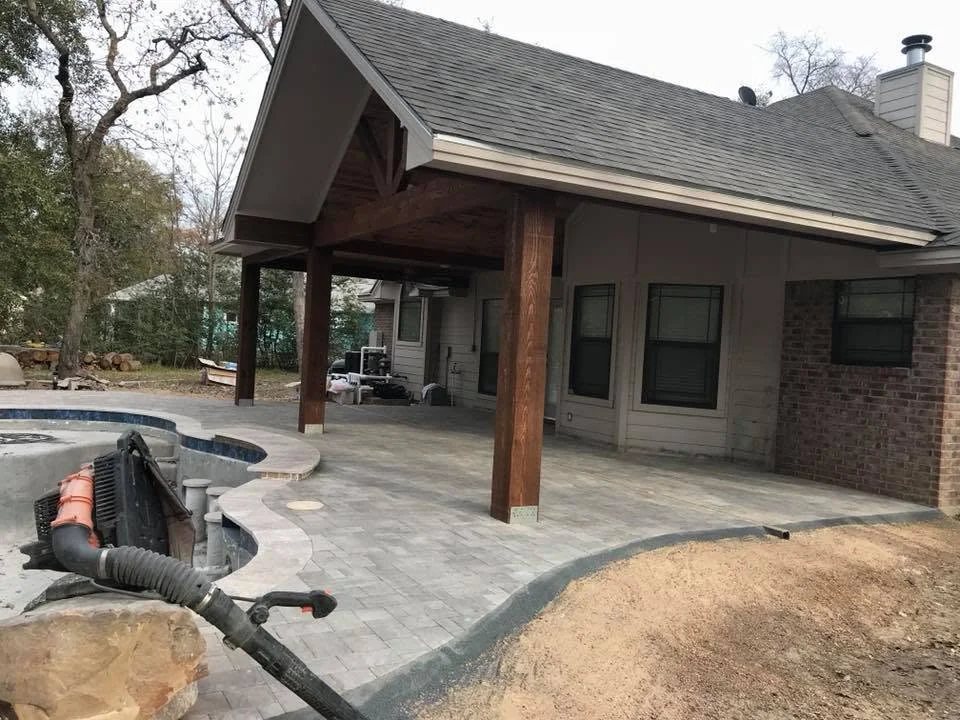
BRYAN, TEXAS — 30.6519° N, 96.3856° W
GET YOUR OWN NUMBER.
Averages only go so far. Send a few photos or have us walk the property, and you get a written estimate for your yard — free.