

2026 PRICING GUIDE
How Much Does a Paver Patio Cost in Bryan–College Station? (2026)
By GreenRiver Landscaping · Updated · 10 min read
Quick answer
A professionally installed concrete paver patio in Bryan–College Station typically runs about $12–$15 per square foot, according to a September 2026 Bryan cost survey, inside a national range of roughly $8–$24.
- Bryan concrete pavers: about $12–$15 per sq ft installed; a 535 sq ft job was estimated at $6,144–$7,467 (Homeyou, Bryan 77801, Sept. 2026).
- National paver patio range: $8–$24 per sq ft, with a 280 sq ft patio averaging about $3,350 (Lawn Love, national).
- Travertine: about $21–$27 per sq ft installed (Homewyse, national, Sept. 2026).
- Flagstone: about $16–$30 per sq ft installed (Fixr and Bob Vila, national).
- Stamped concrete: about $12–$18 per sq ft for mid-range designs; plain poured concrete about $4.40–$16 (Fixr, LawnStarter, national).
- Tearing out an old slab first: about $2–$6 per sq ft (Fixr, national).
Most Bryan–College Station backyard paver patios in the 150–400 sq ft range land somewhere between about $1,800 and $6,000 at the local survey rate, and the base prep on Brazos clay moves the price more than the paver you pick. GreenRiver has not published prices; we quote each patio after seeing the yard, with a free written estimate.
These are published area averages from the sources listed at the end of this guide, not a GreenRiver price list. We quote every job after seeing it, and the estimate is free and in writing.
What actually drives the cost of a paver patio
Five things set the price of a paver patio: its size, the material, how much digging and base the ground needs, what is already there, and how complicated the layout is. The paver itself is usually the smaller part of the bill. Lawn Love’s national numbers put concrete paver material at about $4–$6 per sq ft and labor at about $5–$15 per sq ft, which means most of what you pay for is excavation, base, and hands.
1. Square footage
Size is the biggest single driver because nearly every cost is charged by the square foot. Small patios cost more per foot, though, because mobilizing a crew, a compactor, and a load of base gravel costs about the same for 120 sq ft as it does for 300.
2. Material
Concrete pavers sit at the low end, natural stone at the high end. In published national figures, travertine and flagstone run roughly one and a half to two times the per-foot price of standard concrete pavers.
3. Base depth and excavation
The base is the layer of compacted gravel and sand under the pavers, and on Brazos County clay it is what decides whether the patio stays flat. Deeper excavation means more digging, more hauling, and more gravel, all of which show up in the labor line.
4. What has to come out first
An old concrete slab, a rotted deck, or a few inches of sod and roots all have to be removed and hauled away before any base goes in. Fixr puts concrete removal alone at about $2–$6 per sq ft nationally.
5. Layout, pattern, and add-ons
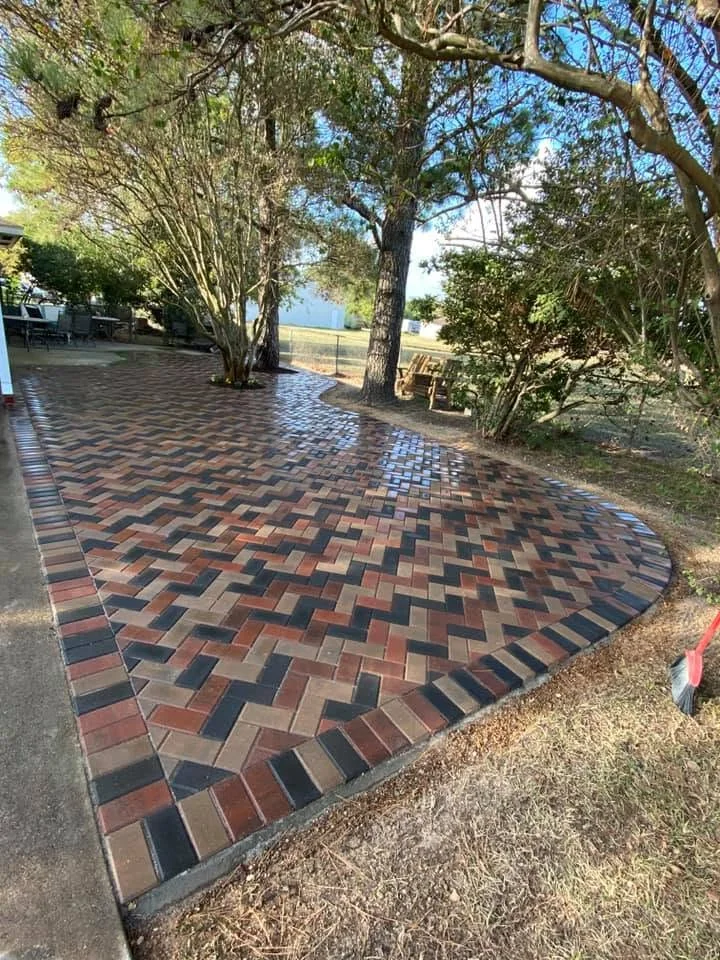
Curves, borders, and patterns like herringbone mean more cuts and more time per square foot. Seat walls, steps, a walkway tie-in, and drainage are priced on top of the patio itself.
Paver patio cost breakdown by component
A paver patio quote breaks into material, labor, base prep, and the extras around it. The ranges below are published third-party figures, labelled as local or national; they are not GreenRiver prices.
| Component | Typical range | Source / notes |
|---|---|---|
| Concrete pavers, installed (Bryan) | $12–$15 per sq ft | Homeyou, Bryan TX 77801, Sept. 2026 |
| Paver patio, installed (national) | $8–$24 per sq ft | Lawn Love, Dec. 2025 |
| Concrete paver material only | $4–$6 per sq ft | Lawn Love, national |
| Installation labor | $5–$15 per sq ft | Lawn Love, national |
| Old concrete slab removal | $2–$6 per sq ft | Fixr, national, Jan. 2025 |
| Concrete block retaining wall | $10–$50 per sq ft of wall face | Fixr, national, Jan. 2025 |
| Paver walkway | $9–$20 per sq ft | LawnStarter, national, Dec. 2025 |
| French drain | $3,296–$9,480 | Fixr, national |
| Sealer | about $200 per 1,000 sq ft | Bob Vila, national |
Concrete pavers vs travertine vs flagstone vs stamped concrete
Concrete pavers are the best value for most Bryan–College Station yards; travertine and flagstone cost more for the look, and poured or stamped concrete is cheaper up front but harder to fix later. All four need the same thing underneath: a compacted base and a slope that moves water away from the house.
| Material | Installed cost per sq ft | Best for |
|---|---|---|
| Concrete pavers | $12–$15 (Bryan); $8–$16 (national) | Most backyards; easy to repair |
| Travertine pavers | $21–$27 | Pool decks, a light surface that reflects sun |
| Flagstone | $16–$30 | Natural, irregular look; garden settings |
| Stamped concrete | $12–$18 mid-range ($8–$30 full range) | Paver look on a slab budget |
| Plain poured concrete | $4.40–$16 | Lowest cost; purely functional |
Concrete pavers
Concrete pavers are the default choice because they are the cheapest segmented surface and every piece can be lifted and reset. The Bryan survey puts them at about $12–$15 per sq ft installed, and LawnStarter’s national range for concrete pavers is $8–$16. They come in dozens of colors and shapes, and patterns like herringbone lock together well under foot traffic.
Travertine
Travertine is a natural limestone paver that costs roughly $21–$27 per sq ft installed by Homewyse’s September 2026 national estimate. Its light color reflects heat, which is why it is common around pools in Central Texas. It is softer and more porous than concrete, so it benefits from sealing and a careful base.
Flagstone
Flagstone is irregular natural stone, and both Fixr and Bob Vila put it at about $16–$30 per sq ft installed nationally. The pieces vary in thickness and shape, so laying it takes more time per square foot than uniform pavers, and that labor is most of the price difference.
Poured and stamped concrete
A plain poured slab is the cheapest patio at about $4.40–$16 per sq ft (LawnStarter, national), and stamping it to look like stone raises that to about $12–$18 for mid-range designs (Fixr). The trade-off is repair: a slab that cracks from clay movement cannot be lifted and reset the way pavers can, and a patched crack in stamped concrete usually shows.
Paver patio cost by size
Multiply the area by the per-foot rate to get a starting range. The figures below apply the Bryan survey rate ($12–$15 per sq ft) and Lawn Love’s national range ($8–$24) to common patio sizes; they are arithmetic on published averages, not quotes.
Small: about 12×12 (144 sq ft)
A 12×12 patio fits a table for four or a pair of chairs and a grill. At the Bryan rate that works out to roughly $1,730–$2,160; at the national range, about $1,150–$3,460. Expect the per-foot price to sit toward the top of any range because setup costs are spread over fewer feet.
Medium: about 16×20 (320 sq ft)
A 16×20 patio holds a dining set and a separate seating area, and it is the size most families end up choosing. At the Bryan rate it comes to roughly $3,840–$4,800; at the national range, about $2,560–$7,680. Lawn Love’s national average for a 280 sq ft patio is about $3,350.
Large: 400–600 sq ft
A 400–600 sq ft patio is an outdoor room, often with a seat wall, a fire pit, or a path to a second area. Lawn Love’s table puts 400 sq ft at $3,200–$9,600 and 600 sq ft at $4,800–$14,400 nationally; at the Bryan rate the same sizes come to about $4,800–$9,000. The Bryan survey’s own 535 sq ft example was $6,144–$7,467.
Base prep on Brazos clay: why patios settle
Patios in Bryan and College Station settle because the clay underneath swells when it is wet and shrinks when it dries, and a thin base cannot bridge that movement. Much of Brazos County sits on expansive clay, and a hot, dry summer followed by a heavy rain moves it more than most soils in the state.
A proper base means digging out the topsoil and organic material, compacting the subgrade, then laying and compacting crushed gravel in layers before a thin sand bed and the pavers. Many patios that fail in this area were laid on a couple of inches of sand over sod, which looks identical on the first day. That is the single most common reason homeowners call about a patio that has sunk or separated.
- Slope: the finished surface should fall away from the house so water runs off rather than soaking the clay at the foundation.
- Edge restraint: a fixed edge keeps the outer pavers from creeping outward as the ground moves.
- Compaction in lifts: gravel compacted a few inches at a time holds; a deep layer compacted once does not.
Base work is where cheap quotes save money, and it is the part you cannot see once the patio is done. More on how we build it is on our patios, walkways and decks page.
Seat walls, retaining walls, steps, and walkways
Walls, steps, and walkways are priced separately from the patio surface and can add as much as the patio itself on a sloped lot.
Seat walls and retaining walls
Fixr puts installed concrete block retaining walls at about $10–$50 per sq ft of wall face nationally, with an average of about $5,463 for a 25-foot wall, 4 feet tall. A seat wall is a short wall built the same way, so it prices off the same per-foot-of-face logic at a lower height. Any wall that holds soil needs gravel and drainage behind it, or the water pressure will lean it forward.
Steps
Steps down from a back door or between levels cost more per square foot than flat paving because each riser has to be built up, set, and capped. Homewyse’s September 2026 national estimate for brick steps is about $29–$38 per sq ft.
Walkways
A paver walkway runs about $9–$20 per sq ft nationally, with an average project of about $2,480 (LawnStarter). A 4-foot-wide, 35-foot path from the driveway to the back patio works out to about $2,030 at their $14.50 average. Tying the walkway into the patio in the same paver usually costs less than building it as a separate job later.
Local factors in Bryan–College Station
Four local conditions change patio cost here: expansive clay, heavy rain events, summer heat, and HOA rules in newer subdivisions.
- Clay soil: deeper excavation and more base gravel than a sandy lot needs, which shows up in labor.
- Heavy rain: storms that drop several inches at once find every low spot. A patio that traps water against the slab or foundation needs drainage work planned in, not added after.
- Heat: dark pavers get hot in July and August. Lighter concrete pavers or travertine are more comfortable barefoot, and that choice can move material cost.
- HOAs and the city: many College Station and south Bryan subdivisions require HOA approval for hardscape, and walls or grade changes near property lines can involve the city. Ask before the crew is scheduled.
- Season: fall and early spring are the busiest times for patio work here, so scheduling lead time is longer then.
Removing an old concrete slab first
Taking out an existing concrete patio typically adds about $2–$6 per sq ft, and Fixr puts a typical patio removal at about $1,000–$2,000 nationally. That covers breaking, loading, and hauling the concrete; the grade underneath usually needs correcting too, because the old slab often settled for the same clay reasons described above.
Replacing a cracked slab with pavers is one of the most common patio projects in older Bryan neighborhoods. You can see examples on our work page.
The 20-year view: pavers vs a slab
Over 20 years, pavers usually cost less to live with than a slab on Brazos clay, because a settled section can be lifted and reset instead of torn out. LawnStarter cites a 25–50 year lifespan for paver patios with proper maintenance.
A poured slab is cheaper on day one, but when clay movement cracks it, the options are to live with the crack, patch it (which shows, especially on stamped concrete), or remove and replace it at $2–$6 per sq ft for removal alone. A settled corner of a paver patio, by contrast, is repaired by pulling the pavers, adding and compacting base, and relaying the same pavers.
Mistakes that cost homeowners money
1. Hiring on price alone
The lowest bid is usually the thinnest base. Two quotes can differ by thousands because one digs deeper and compacts more; the cheaper patio looks the same until the first wet season.
2. Building too small
A table and chairs need more room than most people think once chairs are pulled back. Adding on later means a second mobilization and a visible seam; mark the size out with a hose or paint first.
3. Ignoring where the water goes
A patio is a large hard surface that sheds water. If it slopes toward the house or dams a low spot, you will pay for drainage after the fact, which costs more than planning it in.
4. Choosing dark pavers for a west-facing yard
A dark patio in full afternoon sun can be too hot to walk on in summer. Lighter colors cost about the same and get used more.
5. Skipping edge restraint
Without a fixed edge, the outer rows spread and joints open. It is a small line on the quote and one of the first things cut to lower the price.
How to compare patio quotes
Compare quotes line by line on base depth and scope, not on the bottom number. A written quote for a paver patio should spell out:
- Finished size in square feet and the paver product, color, and pattern.
- Excavation depth and base: type and depth of gravel, how it is compacted, and the sand bed.
- Slope direction and any drainage work included.
- Removal and haul-off of sod, soil, or an old slab.
- Edge restraint type.
- Walls, steps, and walkways as separate lines.
- Cleanup, joint sand, and whether sealing is included.
- Start date and how long the work will take.
GreenRiver does not publish set prices because base depth, access, and drainage change from yard to yard. We look at the site and give a free written estimate that lists each of these. You can request one here, or read about our patio work in College Station.
FAQs
THE SERVICE
Patios, Walkways & Decks from GreenRiver
Stone and paver patios, front walkways, and wood decks, laid over a compacted base so they stay flat and drain properly.
Sources
- Homeyou — Concrete Pavers Costs in Bryan, TX — Bryan, TX 77801; $12–$15/sq ft; 535 sq ft at $6,144–$7,467; updated Sept. 2026
- Lawn Love — How Much Does a Paver Patio Cost? — national; $8–$24/sq ft, size table, material and labor rates; updated Dec. 2025
- LawnStarter — How Much Does a Paver Patio Cost? — national; concrete $8–$16/sq ft; 25–50 year lifespan; Dec. 2024
- LawnStarter — How Much Does a Concrete Patio Cost? — national; poured concrete $4.40–$16/sq ft; Dec. 2024
- LawnStarter — How Much Does a Paver Walkway Cost? — national; $9–$20/sq ft, $2,480 average; Dec. 2025
- Homewyse — Cost to Install Travertine Pavers — national; $21.13–$27.30/sq ft; Sept. 2026
- Homewyse — Cost to Install Brick Steps — national; $29.36–$37.54/sq ft; Sept. 2026
- Fixr — Cost to Build a Patio — national; flagstone $16–$30/sq ft, French drain $3,296–$9,480; Aug. 2022
- Fixr — Stamped Concrete Patio Cost — national; $12–$18/sq ft mid-range, $8–$30 full range; Jan. 2025
- Fixr — Concrete Removal Cost — national; $2–$6/sq ft, patio removal $1,000–$2,000; Jan. 2025
- Fixr — Retaining Wall Cost — national; block $10–$50/sq ft of face, $5,463 average; Jan. 2025
- Bob Vila — Paver Patio Cost — national; flagstone $16–$30/sq ft, sealer about $200 per 1,000 sq ft; Aug. 2023
More cost guides
BRYAN, TEXAS — 30.6519° N, 96.3856° W
GET YOUR OWN NUMBER.
Averages only go so far. Send a few photos or have us walk the property, and you get a written estimate for your yard — free.